
Your cart is currently empty!
🐝 Bee Removal from the Eaves of a Private Property
When a routine call-out turns into a sticky surprise
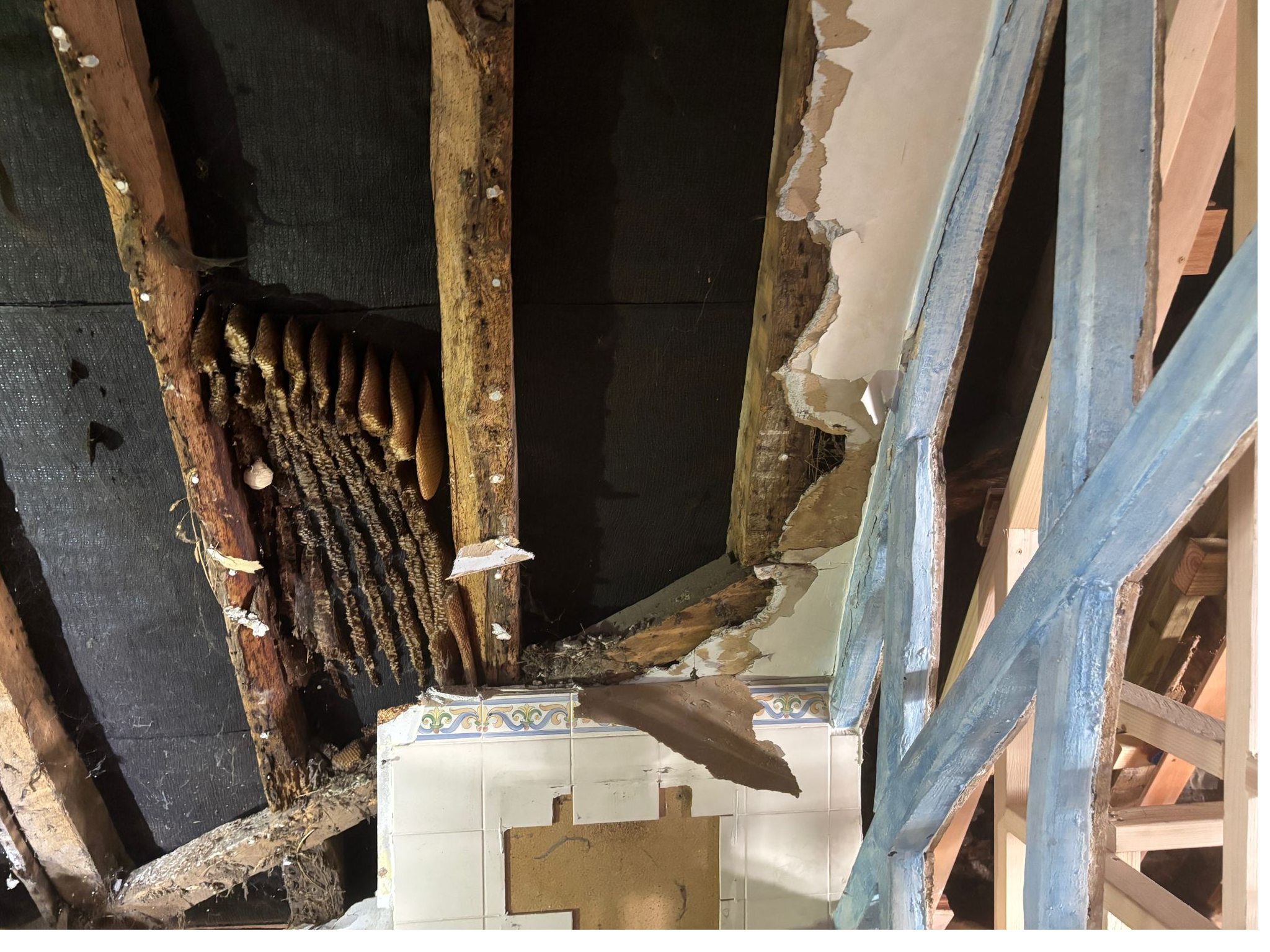
It started with a call from a member of the public who had begun some restoration work on their very old, listed property. While removing a section of ceiling, they discovered something unexpected — a mass of comb and the steady hum of honey bees.
I had two of our members, Anthony and Hils, join me to help as they were going to rehouse the colony. When we arrived at the property, it was immediately clear that the bees had been there for quite some time. They’d made themselves at home deep within the eaves, their comb stretching right down into the ceiling void. Armed with a couple of nuc boxes, a full hive, and the bee vacuum, we got ready to begin the delicate job of removing and rehousing the colony.
Initial Assessment
At first glance, only a small number of bees were visible, but once the remaining section of ceiling was carefully removed, the true scale of the colony became apparent. Layer upon layer of dark comb hung in thick, heavy sheets. The upper sections were almost black — a clear sign that the colony had been established for many years. Older wax darkens over time as brood is raised and debris accumulates, and this comb was among the oldest I’d ever seen.
The colony itself was clustered toward the bottom, where the bees had been raising brood and storing their winter supplies.

The Removal Process
The first step was to remove the excess comb and expose the main frames of the nest. Working slowly and carefully, we began cutting sections of comb free, placing the brood comb directly into empty frames that would later sit inside a hive. This allowed the bees to continue caring for their brood once rehoused. The honey, however, proved more problematic — dripping everywhere as we worked — but Anthony and Hils managed to hold it within the empty frames so the colony would still have some of their own stores to take forward into winter.
Using the bee vac, the remaining workers were gently collected from the ceiling and surrounding areas. The vacuum provides a controlled, low-suction way to gather bees safely without harm — invaluable when working in confined or awkward spaces like this.
As more of the ceiling came down, the extent of the honey stores became apparent. We estimated there were at least three full supers’ worth of honey — all now dripping and oozing from broken comb. It quickly became a sticky, chaotic scene, with honey covering tools, gloves, and pretty much everything else within reach!
A Colony with History
Given the condition of the comb and the depth of the nest, it’s likely this colony had been thriving in that spot for several years, perhaps even decades, with successive swarms returning each season. Bees often find the eaves of older properties particularly appealing — the timber voids provide warmth, dryness, and shelter, while the smallest gaps in beams or tiles offer easy access.
For listed or heritage buildings, that can be a challenge. Any removal must be done carefully to preserve the structure and avoid damage to decorative plasterwork or beams. Later the owners found some abandoned comb further inside the eaves, probably a swarm which had died out at some point.
Aftercare and Clean-Up
Once the bees and brood were safely transferred into the hive, & we had removed most of the comb and bees, the owners were happy to carry out the final removal of all traces of wax and honey from the cavity. This is a crucial step: if residue remains, the scent will attract new swarms in the future. The property owners were advised to seal the access points once the area had fully dried.
The colony was relocated to a new apiary site where they could be monitored and allowed to rebuild on fresh frames. Despite the sticky conditions and late hour, it was a satisfying recovery — rescuing a long-established colony from an unsuitable home while preserving the integrity of a beautiful old building. They are surviving well.
Bees in eaves are a common but complex challenge, especially in older or listed properties. Removing them safely requires patience, the right equipment — such as nuc boxes, hives, and a bee vac — and a careful, methodical approach.
This particular colony left behind a sticky reminder of how adaptable bees can be and how long they can thrive undisturbed. With respect, care, and a little honey-scented hard work, both the bees and the building were given a fresh start.
Only 3 bee-suits were harmed in this process….. 🙂

Posted